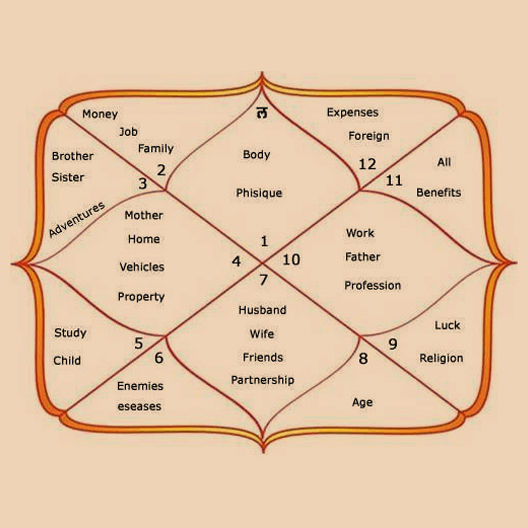
The 12 Houses in Vedic Astrology: The Blueprint of Human Destiny
The Cosmic Blueprint of Life
From the moment of birth, every individual steps into a cosmic design shaped by invisible forces. In Vedic Astrology, this divine pattern is organized through twelve celestial divisions, known as Bhavas or Houses. These houses form the foundation of the horoscope — a sacred map where the movements of planets unfold the story of one’s life.
Each house mirrors a unique dimension of human experience — from physical existence to emotional growth, from worldly achievements to spiritual liberation. Together, they represent the full spectrum of life’s journey, revealing how destiny flows through different areas such as health, wealth, relationships, and purpose.
The planets (Grahas) act as cosmic messengers, transmitting their energy through these houses. Their position within each house determines how one experiences success, challenges, and evolution at both material and spiritual levels.
Understanding all twelve houses allows an astrologer to interpret any horoscope with accuracy and depth, uncovering how the soul interacts with the world through time and karma.
What Are the 12 Houses in Vedic Astrology?
In Vedic Astrology, the term Bhava signifies a field of experience where planetary karma manifests. Each house acts as a distinct realm of life, capturing the way cosmic forces influence one’s actions, emotions, and destiny. Together, the twelve houses create the complete framework of a horoscope, allowing astrologers to read the subtle design of a person’s journey.
The astrological chart is a 360° circle, symbolizing the full spectrum of existence. This circle is divided into twelve equal parts of 30° each, forming the twelve houses. Every house governs a specific area — such as self, wealth, communication, home, or career — offering insight into both material and spiritual dimensions of life.
The starting point of any birth chart is the Ascendant (Lagna) — the zodiac sign rising on the eastern horizon at the time of birth. This becomes the 1st house, setting the foundation for all others. From this point, the sequence of houses unfolds in an anti-clockwise direction, each representing a new stage of human evolution.
Each house also has a ruling planet, known as the Bhavesha or House Lord. The placement of this planet in the chart — whether strong, weak, exalted, or afflicted — greatly influences how the energy of that house expresses itself in life. For instance, when the 10th house lord is powerful, it often brings prominence and achievement in career.
The twelve-house system is represented in the main birth chart (D1 or Rashi chart) — the fundamental diagram used to analyze a person’s overall life pattern. This structure forms the base for all divisional charts in Vedic Astrology, revealing the balance between destiny and free will.
How Houses Shape Human Life
Every event, relationship, and turning point in life can be traced through the twelve houses of a horoscope. Each house governs a specific domain of human experience — the 1st relates to identity and health, the 2nd to wealth and family, the 3rd to courage and communication, the 4th to home and emotional foundation, and so on. Collectively, they map how an individual interacts with the world, evolves through challenges, and fulfills inner purpose.
The houses act as portals of karma, through which the results of past actions unfold in the present. When planets occupy or aspect these houses, they activate corresponding life areas — shaping opportunities, challenges, and lessons that guide personal growth. Through this dynamic interaction, the horoscope becomes a living reflection of one’s karmic journey.
In Vedic Astrology, houses are also categorized by their spiritual function and energetic strength:
- Kendra Houses (1st, 4th, 7th, 10th): Represent stability, foundation, and action — the pillars of life.
- Trikona Houses (1st, 5th, 9th): Symbolize purpose (dharma), creativity, and divine fortune.
- Dusthana Houses (6th, 8th, 12th): Indicate transformation through service, discipline, or surrender — leading ultimately to growth and liberation.
For instance, the 1st, 5th, and 9th houses form the Trikona or “triangle of destiny,” reflecting one’s righteous path and blessings earned through virtue. When benefic planets strengthen these houses, they bring alignment between effort, wisdom, and divine grace.
The 12 Houses and Their Core Meanings
Each of the twelve houses in Vedic Astrology governs a specific sphere of life. Together, they form the complete blueprint of human experience — from birth and family to career, relationships, and spiritual awakening.
Below is a concise overview of all twelve houses with direct links to explore each one in depth.
House
- 1st House (Lagna) – Represents self, body, and identity. It defines appearance, vitality, and the overall direction of life.
- 2nd House – Governs wealth, family values, speech, and accumulated possessions. It shows how one earns, saves, and expresses worth.
- 3rd House – Reflects courage, communication, skills, and effort. It also rules siblings, determination, and short journeys.
- 4th House – Symbolizes home, mother, emotional security, and comfort. It reveals one’s roots, inner peace, and real estate matters.
- 5th House – Represents creativity, intelligence, children, and romance. It also connects with education, inspiration, and past-life merits.
- 6th House – Governs health, service, competition, and daily routine. It reveals how one handles challenges, discipline, and responsibilities.
- 7th House – The domain of partnerships, marriage, and business alliances. It shows how one relates to others and builds balanced connections.
- 8th House – Represents transformation, longevity, inheritance, and mysticism. It deals with secrets, change, and spiritual rebirth.
- 9th House – The house of fortune, higher learning, and dharma. It relates to wisdom, ethics, teachers, and long-distance travels.
- 10th House – Rules career, karma, reputation, and authority. It shows one’s achievements, profession, and public recognition.
- 11th House – Signifies gains, aspirations, friendships, and social success. It reflects how one manifests ambitions and collective prosperity.
- 12th House – Represents liberation, solitude, and spiritual retreat. It connects with foreign travel, detachment, and ultimate freedom.
Each house reveals a hidden story of your destiny.
Dive deeper into your personal horoscope through these detailed guides and explore how planetary energies shape every area of life.
The Axis Principle: Opposite Houses and Life Balance
In the cosmic design of Vedic Astrology, the twelve houses operate in pairs of polarity — each house facing its exact opposite across the zodiac wheel. These opposite houses form energetic axes that reveal the dual forces shaping human life. Just as day complements night and action complements rest, each house finds deeper meaning through its counterpart.
These axes are not oppositions in conflict but complementary streams of consciousness that balance the inner and outer dimensions of existence. Understanding them helps interpret the chart in a holistic way, showing how different aspects of life support and refine one another.
Major House Axes in Vedic Astrology
In every horoscope, opposite houses form powerful energy pairs that balance different areas of life. Each axis reflects the dynamic exchange between self and others, inner and outer, material and spiritual realms.
Dharma Houses — 1st, 5th, and 9th
The first house represents individuality and self-expression, while the seventh house governs unions and relationships. Together, they reflect the eternal dance between independence and togetherness. A strong balance here creates harmony in both personal confidence and meaningful partnerships.2nd ↔ 8th House — Wealth and Transformation
The second house symbolizes stability, possessions, and material values, while the eighth signifies change, shared resources, and inner renewal. This axis teaches how true security arises through transformation — balancing accumulation with surrender.4th ↔ 10th House — Home and Career
The fourth house anchors emotional peace and private life, while the tenth governs profession, reputation, and public standing. This pair highlights the need to harmonize inner comfort with outer achievement — a vital equilibrium for lasting success.5th ↔ 11th House — Creativity and Gains
The fifth house radiates personal talent, joy, and expression, while the eleventh focuses on collective goals and material rewards. Together, they emphasize how creativity contributes to social prosperity and how inspiration fuels progress.6th ↔ 12th House — Service and Surrender
The sixth house involves work, discipline, and overcoming difficulties, while the twelfth relates to detachment, rest, and spiritual release. This axis reveals how service in the material world prepares the soul for liberation and peace.
Each axis demonstrates the balance between two life forces — self and others, creation and transformation, effort and transcendence. When interpreted together, these pairs reveal how destiny weaves dual experiences into one complete journey of growth and realization.
The Role of Planets in Houses
In Vedic Astrology, the twelve houses act as cosmic fields, while the nine planets serve as dynamic forces expressing energy within those fields. Every planet reveals a different dimension of consciousness, and the house it occupies defines where that energy manifests in life.
Thus, when a planet moves through or resides in a specific house, it colors that domain with its natural qualities — shaping experiences, desires, challenges, and achievements. This interaction between planetary nature and house significance is the essence of astrological interpretation.
Planetary Behavior through the Houses
Each planet behaves differently depending on its position:
- Sun in the 10th House strengthens authority, ambition, and leadership — ideal for those seeking recognition and success.
- Moon in the 4th House nurtures emotional security, comfort, and deep connection with family and home life.
- Mercury in the 3rd House enhances intellect, communication, and analytical thinking — creating strong writers, teachers, or strategists.
- Venus in the 7th House inspires charm, harmony, and balance in relationships.
- Mars in the 6th House gives courage and discipline to overcome obstacles through determined effort.
Exaltation and Debilitation
Planets have special zones of strength and sensitivity.
- A planet in exaltation expresses its highest virtues — radiating clarity, power, and purpose.
- A debilitated planet, however, may express its qualities more subtly, guiding the individual toward self-improvement and awareness.
For example:
- The Sun is exalted in Aries and functions with strong vitality and confidence.
- The Moon feels exalted in Taurus, bringing emotional steadiness and peace.
Functional Benefic and Malefic Logic
Beyond their natural nature, planets act as functional benefics or malefics based on the ascendant. A planet that rules auspicious houses often blesses, while one governing challenging houses may create trials that promote growth. Understanding this logic allows astrologers to identify where life may flow easily and where conscious effort is needed.
When combined, these principles show how planetary placement personalizes the horoscope, transforming a general chart into a living map of purpose, talent, and evolution.
House Lords and Their Influence
Every house in Vedic Astrology is governed by a ruling sign and a lord planet, known as the Bhavesha. This lord acts as the manager of that house, determining how its energy unfolds through life. While the house defines what area of life is influenced, the house lord reveals how and to what degree those experiences manifest.
The Connection Between House and Lord
When the house lord occupies a particular position in the chart, it forms a powerful energetic bridge between two life domains. The sign and house placement of the lord decide whether that area of life will express strength, harmony, or transformation.
For example:
- The 10th lord (House of Career) in the 7th House (House of Partnership) indicates professional success through collaborations, joint ventures, or public dealings.
- The 4th lord (House of Home) in the 12th House (House of Moksha) may point toward living abroad or finding inner peace away from one’s birthplace.
- The 2nd lord (House of Wealth) in the 11th House (House of Gains) often supports steady financial growth and social influence.
Why House Lords Matter
House lords reveal the interconnection of life events — how family influences career, how love impacts wealth, and how personal growth shapes destiny. They also guide prediction accuracy in timing events, since the planetary periods (Dashas) activate their promises.
Understanding the behavior of each house lord offers a profound view of life’s internal structure — the unseen logic behind prosperity, relationships, and spiritual progress.
Houses and the Four Purusharthas
In Vedic philosophy, human life is guided by four sacred goals known as the Purusharthas — Dharma (righteous purpose), Artha (material prosperity), Kama (fulfillment of desires), and Moksha (spiritual liberation). These four aims define the rhythm of existence, from worldly responsibilities to ultimate freedom.
Vedic Astrology beautifully reflects this spiritual architecture through the twelve houses, where each group of three houses aligns with one of the Purusharthas. Together, they illustrate the cyclic evolution of the soul, guiding every individual from self-discovery to enlightenment.
The Four Cycles of Life through the Houses
In Vedic Astrology, the twelve houses are grouped into four spiritual pursuits called Purusharthas — guiding human life through Dharma, Artha, Kama, and Moksha.
Dharma Houses — 1st, 5th, and 9th
- Represent moral strength, creativity, and higher wisdom.
- The 1st house defines self-identity, the 5th inspires purpose, and the 9th uplifts through faith and philosophy.
- These houses align with one’s duty and life mission — the path of righteousness.
Artha Houses — 2nd, 6th, and 10th
- Symbolize wealth, effort, and professional achievement.
- The 2nd house governs resources, the 6th refines discipline, and the 10th rewards diligence with recognition.
- These domains support material security and responsible action in the world.
Kama Houses — 3rd, 7th, and 11th
- Express desires, relationships, and social engagement.
- The 3rd house encourages self-expression, the 7th builds partnership, and the 11th fulfills aspirations through networks and success.
- Together, they reflect the pursuit of joy and meaningful connection.
Moksha Houses — 4th, 8th, and 12th
- Represent emotional depth, transformation, and liberation.
- The 4th house holds inner peace, the 8th reveals hidden truths, and the 12th leads toward spiritual release.
- These houses open the door to inner awakening and transcendence.
The Evolutionary Pattern
This cyclic design — Dharma → Artha → Kama → Moksha — repeats through the zodiac, reminding that material life and spiritual growth coexist as part of one continuous journey. Understanding these layers helps reveal where the soul stands in its progression and what lessons each phase brings.
Reading Life Through 12 Windows of the Soul
Every birth chart is a sacred mirror — a reflection of the universe within. The twelve houses in Vedic Astrology act as twelve windows through which the soul experiences life. Each house reveals a distinct rhythm of karma, purpose, and destiny, guiding an individual through the evolving chapters of existence.
To truly understand one’s path, every house must be seen in unity — as parts of a single cosmic design. The 1st house shows who we are; the 4th reveals our emotional roots; the 10th expresses our karma in the world; and the 12th opens the door to liberation. Together, they tell the story of life’s complete journey — from birth to realization.
When the positions of planets, house lords, and aspects are interpreted holistically, astrology transforms into a language of self-awareness. It offers not only prediction but profound insight into why experiences unfold as they do — and how they lead toward spiritual balance.
Understanding these twelve houses allows you to interpret any horoscope with clarity and compassion, illuminating both your challenges and your highest potential.
Ready to decode your birth chart?
Explore each house in detail or request a personalized consultation with Rajveer Patel →
